Throughout the 2012 year of the Remarkable Women in Taos, the Museum
Association of Taos is featuring exhibitions on women artists drawn from their
collections. This is the first of a series covering these exhibitions and introducing you, dear readers, to the breadth and depth of women's contributions to the creative arts of Taos.

In her book Taos and Its Artists
(1947), Mabel Dodge Luhan listed 20 female artists. Although I knew
their names, I
had never seen photos of some of them or examples of their work. The exhibition "Out of
the Background: Women Artists of Early Taos" (now up at the E. L.
Blumenschein Home and Museum) changed that. Several of
these featured artists were married to Taos Society of Artists members and some trained as artists. Of the early arrivals in the
first two decades of the 20th century, once resident in Taos, many of
these artists sublimated their
careers to care for husbands and family. Up until the 1930s most Taos
households didn't have electricity, running water, phones, indoor bathrooms and
other modern conveniences of cities these women had left in order to live in this remote landscape.
To give
you an overview of the earliest women artists, I have selected two
artists Mabel mentioned in her book--Mary Greene Blumenschein and Mrs. Frank Cheetham--and four artists she did not mention: Lucy
Harwood,
Virginia Couse, Mary Ufer and
Helen Martin--who are included in "Out
of the Background."
In the first pages of Taos and Its Artists, Mabel mentions 32 male artists, including pioneers
Ernest Blumenschein and Bert Phillips and modernists Andrew Dasburg and
Emil Bisttram. After introducing many of them, Mabel wrote:
There
is an attractive group of women artists in Taos, cosmopolitan,
industrious, and sociable. It is amazing that some of these women,
accustomed as they are to the life of cities both here and in Europe, to
the glamour of Spain, the artless natural charm of Bavaria, the
brilliant salons of Paris, are content to struggle with the daily
inconveniences of Taos life.
Indeed
Mary Blumenschein's initial period in Taos lasted less than 2 weeks. In 1913, coaxed to try living in the remote village by her husband, Ernest, she bravely agreed. When she and 4-year-old Helen arrived in 1913, the family stayed in
rented rooms in the Wengert boarding house. Having no fresh dairy milk available for their sickly daughter, no electricity,
and no house to make a home, when a diptheria outbreak
threatened days later, Mary "threw down the gauntlet," packed up Helen and their luggage, and returned to the civilized world of New York and the sanctuary of the Greene family home in
Brooklyn.
 |
| Mary Greene Blumenschein in New York studio, ca. 1918 |
|
Of course, my early interest in Ernest Blumenschein,
founding member of the Taos Society of Artists, led me to research and write
about the woman who became his wife, Mary Shepard Greene (1869-1958). I
discovered that by the time Blumenschein met Mary in 1904, she was already an
acclaimed artist. In 1900 and again in 1902, she won medals in the prestigious
Paris Salon, the second American woman ever to be so honored: the first was
impressionist painter Mary Cassatt. After her marriage to Ernest Blumenschein
in June 1905, Mary also took on illustrating commissions for both books and
magazines. Mary became a celebrated illustrator in New York for popular
magazines like Town and Country, The American Magazine, Ladies Home Journal, Good
Housekeeping and Collier’s. (Mabel noted Mary's illustrations in many books.) Her illustration career ended in 1919 when the
Blumenscheins moved to Taos.
There Mary devoted most of
her time to providing a beautiful and comfortable home--an important expression of
her personal aesthetic and design sensibilities--for
her husband and
daughter. Her art took a back seat to the needs and desires of her
family and to entertaining guests. In
1922, Mary began to design and fabricate her own line of jewelry, a
craft she
maintained through the remainder of her life. Mary's jewelry was
exhibited as part of her husband's solo show at New York's Grand Central
Art Galleries in 1927. Mary's silver work was later exhibited at the
International Folk Art Museum and the Museum of Fine Arts in Santa Fe.
 |
| Husking Corn (1939) |
Mary also painted occasionally. Her Husking Corn (1939) received a favorable review in the New York Herald Tribune
when the painting was exhibited a year later at the National Academy of Design. In
March 1940 art critic Royal Cortissoz wrote: “There is the exhilaration
of the open air in the
‘Husking Time’ of Mary G. Blumenschein.” In the 1940s Mary produced color pencil drawings based on the story of the Arabian
Nights for a prospective book, which due to paper shortages during World War
II, was never published.
 |
Portrait of Lucy Case Harwood (ca. 1890)
Courtesy the Harwood Museum of Art |
While
the Blumenscheins were in Paris, they met Burt and Lucy Harwood. (In fact, Ernest Blumenschein told the
Harwoods about Taos.) Both Burritt Harwood and Elizabeth "Lucy" Case
(1867-1938) were
born in Charles City, Iowa. In her youth, the adventurous Lucy had
traveled
with her lawyer father to Mexico, where the two explored the country on
their own, without guides. She graduated from Vassar at a time
when few young women went to college. This background and a love of the
arts made Lucy a perfect wife for photographer and painter Burt
Harwood.
Following several year's study at the Academie Julian in Paris beginning in 1885, Burt relocated in Minneapolis where he painted portraits and operated his own art school.
Lucy was one of his students. Burt married her in 1896 and the
couple honeymooned in Paris. At home in France, they lived in Paris and Brittany for 20 years. During this time Lucy studied with James McNeill Whistler, and she and Burt spent
summers painting in Brittany. During World War I the Harwoods maintained
a hospital in France for the war wounded until the United States declared war on
Germany.
 |
| Church at Chimayo (UR) by Lucy, Photo of Harwood home by Burt Harwood. |
In
1916 the Harwoods arrived in Taos and bought property from Captain
Simpson. They added on rooms to the home they dubbed "El Pueblito"
because it was built in the style of Taos Pueblo. The Harwood's home was
the first in Taos to have electricity and the largest one of this type until Mabel built "El Gallo" in 1922, the
same year that Burt Harwood died.
Early on Lucy had operated the town's first
lending library out of the Harwood home. The year after Burt's death,
with the help of Taos Society of Artists members Bert Phillips and Victor Higgins and other friends, she incorporated the Harwood Foundation, meant to
"establish and maintain...a public library, a museum and other
educational agencies." Lucy gifted Burt's large collection of
photographs as well as the couple's paintings. Other donations from community--including books and a collection of santos from Mabel,
paintings and sculpture by Taos artists, wood sculpture by Patrocino
Barela and Hispanic folk art and textiles--added to the Harwood's seed collection. Lucy bequeathed the Harwood
Foundation to the University of New Mexico in 1935 and lived on the
property until her death three years later.
 |
| Virginia Couse in her Taos home |
Raised on a ranch in Klikitat County, Washington,
Virginia Walker (1860-1929) wished to become an illustrator. Toward that end
she started art studies in 1882 at the Philadelphia School of Design, and
furthered her training at the National Academy of Design three years later.
Attracted like countless other aspiring art students, she sailed for Paris in
1887. She studied in this art mecca for the next three years, first at the
Academy Colorossi, then at the Academie Julian. During her first week in Paris,
Virginia met fellow American art student, Eanger Irving Couse. Immediately
attracted to each other, the two married in Paris in 1889.
 |
| The Portal by Virginia Couse |
Although her husband encouraged his wife's artistic pursuits, eye trouble forced Virginia to give up her dream of becoming an illustrator. Like other American women of her time, she instead devoted her talent to creating an artistic home environment.
Encouraged to come to Taos by Ernest Blumenschein (Irving Couse became a founding member of the Taos Society of Artists), when the Couses bought a house and property on Kit Carson Road in 1909, Virginia gave in to her passion for gardening. She leveled and terraced the land around their home, built rock walls, designed flower beds and garden paths, and installed stone seats to enjoy the garden and the surrounding view.
 |
| Gardens at the Couse House, Virginia Couse's legacy |
When friends and visitors arrived to see paintings in Couse's studio, they also took time to stroll through the gardens that many newspaper articles had lauded. Virginia's was the first such flower
garden in Taos, and she shared seeds and plants with all newcomers to
town. Because of this, her creation became known as the “the Mother Garden” of Taos.
 |
| Mary Monrad Frederikson |
|
|
Born in
Copenhagen, Denmark, Mary Monrad Frederikson (1869-1947) studied art at the Academie Julian in Paris and took classes with James McNeill Whistler. Later, while attending classes
at the J. Francis Smith Academy, a Chicago division of the Academy Julian,
Mary met Walter Ufer who would become her husband and a member of the Taos Society of Artists. Once married to Ufer, Mary supported him and encouraged him to leave illustration and take up portrait painting. Through this endeavor, Chicago Mayor Carter Harrison noticed Ufer's work, and encouraged him to go to Taos to paint. Harrison become Ufer's patron, and the Ufers subsequently moved to Taos.
 |
| Alice in Big Chair by Mary Ufer |
After settling in
Taos, Mary continued to paint but Walter’s alcoholism, increasingly poor
health, debts and the low demand for his paintings put a strain on their marriage.
To help with finances, Mary delivered lantern-slide lectures on artists both at the Art Institute of Chicago and on a traveling lecture circuit. When Walter Ufer died of appendicitis in 1936, Mary's life became more difficult. For a while she was employed as an artist under New Mexico's Works Progress Administration. Then she was disqualified from the WPA program because she was over 65 years old. After moving to New York, Mary eventually secured work with that state's WPA program. Money from Social Security augmented her meager income until her death in 1947.
 |
| Edith Evelyn Higgins Cheetham |
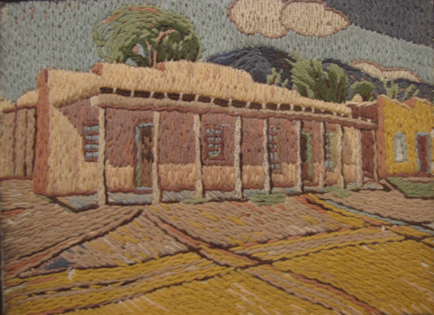
Edith Evelyn Higgins (1870-1955) was born on the family farm in Cook County, Illinois (near present-day O'Hare Airport), then moved with her family to Kansas while still a young girl. There she met and married lawyer Frank Cheetham. In 1911 the Cheethams and their two sons relocated to Taos where he established a law practice. Part of the social scene, Edith mingled with members of the Taos Society of Artists and their wives. Although she never had formal art training, she showed her paintings alongside other New Mexico artists at the Harwood Foundation in Taos and at the Museum of Fine Arts (now the New Mexico Museum of Art) in Santa Fe. Like Rebecca James (to be covered in part two), she also made paintings using colcha embroidery techniques introduced to Taos in the Spanish Colonial era. (Mabel praised Mrs. Frank Cheetham "who makes the best cakes in the Taos Valley" for her small intimate scenes of "this neighborhood.")
 |
| Kit Carson Home (colcha embroidery) |
Adjunct to her
painting, Edith pursued interests in doll making. By the 1940s she had
abandoned painting and devoted space and energy to the "little doll
factory" in her home. This served her well as she was able to support
herself through doll-making in the years after her husband's death in
1946.
 |
| Helen Campbell Martin |
The artistic talent Helen Campbell (1888-1957) brought to Taos when she married Dr. T. P. "Doc" Martin in 1917 centered on music. Doc, known as a 'horse and buggy doctor', had established his practice decades earlier and had hosted the formative meeting of the Taos Society of Artists in 1915. He was a civic-minded and well respected man in the community. Helen was already an accomplished violinist, but within months shifted her interest to the visual arts after exposure to other artists' work in the growing Taos colony. Her interest in fabric design blossomed after she learned the rudiments of the Oriental art of batik from Santa Fe artist Olive Rush.
 |
| Untitled Batik wall hanging |
Helen soon developed her own colors and treatment that she used in signature scarves, shawls, dresses and wall hangings. Women from high society in cities like New York, Paris and London clamored after Helen's dinner gowns, tea dresses and chiffon wraps. Her batik business flourished from 1920 until 1935 when her husband died. Helen inherited several buildings and called in outstanding debts (Doc seldom sent out bills) for labor to build up and open the Martin Hotel in 1936. From that time until her death in 1957, Helen put her energies into building what is now The Taos Inn, a landmark known as "the living room of Taos" that still extends the hospitality originally offered by Helen and Doc Martin.
I hope you enjoyed meeting these early women artists AND if you're in town, please check out this exhibition. It's a MUST SEE, up until May 15th. If you don't make it, click on the Blumenschein Home and Museum link above, and you can take a brief virtual tour of "Out of the Background."
This begins to address "Who are the remarkable women of Taos?" Next I'll be in the kitchen with Mabel and the Remarkable Women Chefs of Taos, with Part Two of "Out of the Background" to follow after that.
Adios for now,
Liz
Thank you to Anita McDaniel, curator, Taos Historic Museums for photo and text assistance (and an insightful, interesting exhibition of the early women artists of Taos), and to Nancy Delpero, marketing and public relations at the Taos Historic Museums for the virtual video tour of the "Out of the Background" exhibition. Photos and images presented here are part of the exhibition.