Sunday, April 29, 2012

Mabel Dodge Luhan and Early Women Artists of Taos, part one

Throughout the 2012 year of the Remarkable Women in Taos, the Museum Association of Taos is featuring exhibitions on women artists drawn from their collections. This is the first of a series covering these exhibitions and introducing you, dear readers, to the breadth and depth of women's contributions to the creative arts of Taos.


In her book Taos and Its Artists (1947), Mabel Dodge Luhan listed 20 female artists. Although I knew their names, I had never seen photos of some of them or examples of their work. The exhibition "Out of the Background: Women Artists of Early Taos" (now up at the E. L. Blumenschein Home and Museum) changed that. Several of these featured artists were married to Taos Society of Artists members and some trained as artists. Of the early arrivals in the first two decades of the 20th century, once resident in Taos, many of these artists sublimated their careers to care for husbands and family. Up until the 1930s most Taos households didn't have electricity, running water, phones, indoor bathrooms and other modern conveniences of cities these women had left in order to live in this remote landscape. 

To give you an overview of the earliest women artists, I have selected two artists Mabel mentioned in her book--Mary Greene Blumenschein and Mrs. Frank Cheetham--and four artists she did not mention: Lucy Harwood, Virginia Couse, Mary Ufer and Helen Martin--who are included in "Out of the Background."

In the first pages of Taos and Its Artists, Mabel mentions 32 male artists, including pioneers Ernest Blumenschein and Bert Phillips and modernists Andrew Dasburg and Emil Bisttram. After introducing many of them, Mabel wrote:

There is an attractive group of women artists in Taos, cosmopolitan, industrious, and sociable. It is amazing that some of these women, accustomed as they are to the life of cities both here and in Europe, to the glamour of Spain, the artless natural charm of Bavaria, the brilliant salons of Paris, are content to struggle with the daily inconveniences of Taos life.

Indeed Mary Blumenschein's initial period in Taos lasted less than 2 weeks. In 1913, coaxed to try living in the remote village by her husband, Ernest, she bravely agreed. When she and 4-year-old Helen arrived in 1913, the family stayed in rented rooms in the Wengert boarding house. Having no fresh dairy milk available for their sickly daughter, no electricity, and no house to make a home, when a diptheria outbreak threatened days later, Mary "threw down the gauntlet," packed up Helen and their luggage, and returned to the civilized world of New York and the sanctuary of the Greene family home in Brooklyn.

Mary Greene Blumenschein in New York studio, ca. 1918


Of course, my early interest in Ernest Blumenschein, founding member of the Taos Society of Artists, led me to research and write about the woman who became his wife, Mary Shepard Greene (1869-1958). I discovered that by the time Blumenschein met Mary in 1904, she was already an acclaimed artist. In 1900 and again in 1902, she won medals in the prestigious Paris Salon, the second American woman ever to be so honored: the first was impressionist painter Mary Cassatt. After her marriage to Ernest Blumenschein in June 1905, Mary also took on illustrating commissions for both books and magazines. Mary became a celebrated illustrator in New York for popular magazines like Town and Country, The American Magazine, Ladies Home Journal, Good Housekeeping and Collier’s. (Mabel noted Mary's illustrations in many books.) Her illustration career ended in 1919 when the Blumenscheins moved to Taos.

There Mary devoted most of her time to providing a beautiful and comfortable home--an important expression of her personal aesthetic and design sensibilities--for her husband and daughter. Her art took a back seat to the needs and desires of her family and to entertaining guests. In 1922, Mary began to design and fabricate her own line of jewelry, a craft she maintained through the remainder of her life. Mary's jewelry was exhibited as part of her husband's solo show at New York's Grand Central Art Galleries in 1927. Mary's silver work was later exhibited at the International Folk Art Museum and the Museum of Fine Arts in Santa Fe. 

Husking Corn (1939)


Mary also painted occasionally. Her Husking Corn (1939) received a favorable review in the New York Herald Tribune when the painting was exhibited a year later at the National Academy of Design. In March 1940 art critic Royal Cortissoz wrote: “There is the exhilaration of the open air in the ‘Husking Time’ of Mary G. Blumenschein.” In the 1940s Mary produced color pencil drawings based on the story of the Arabian Nights for a prospective book, which due to paper shortages during World War II, was never published.


Portrait of Lucy Case Harwood (ca. 1890) 
Courtesy the Harwood Museum of Art


While the Blumenscheins were in Paris, they met Burt and Lucy Harwood. (In fact, Ernest Blumenschein told the Harwoods about Taos.) Both Burritt Harwood and Elizabeth "Lucy" Case (1867-1938) were born in Charles City, Iowa. In her youth, the adventurous Lucy had traveled with her lawyer father to Mexico, where the two explored the country on their own, without guides. She graduated from Vassar at a time when few young women went to college. This background and a love of the arts made Lucy a perfect wife for photographer and painter Burt Harwood. 

Following several year's study at the Academie Julian in Paris beginning in 1885, Burt relocated in Minneapolis where he painted portraits and operated his own art school. Lucy was one of his students. Burt married her in 1896 and the couple honeymooned in Paris. At home in France, they lived in Paris and Brittany for 20 years. During this time Lucy studied with James McNeill Whistler, and she and Burt spent summers painting in Brittany. During World War I the Harwoods maintained a hospital in France for the war wounded until the United States declared war on Germany.


Church at Chimayo (UR) by Lucy, Photo of Harwood home by Burt Harwood.

In 1916 the Harwoods arrived in Taos and bought property from Captain Simpson. They added on rooms to the home they dubbed "El Pueblito" because it was built in the style of Taos Pueblo. The Harwood's home was the first in Taos to have electricity and the largest one of this type until Mabel built "El Gallo" in 1922, the same year that Burt Harwood died. 

Early on Lucy had operated the town's first lending library out of the Harwood home. The year after Burt's death, with the help of Taos Society of Artists members Bert Phillips and Victor Higgins and other friends, she incorporated the Harwood Foundation, meant to "establish and maintain...a public library, a museum and other educational agencies." Lucy gifted Burt's large collection of photographs as well as the couple's paintings. Other donations from community--including books and a collection of santos from Mabel, paintings and sculpture by Taos artists, wood sculpture by Patrocino Barela and Hispanic folk art and textiles--added to the Harwood's seed collection. Lucy bequeathed the Harwood Foundation to the University of New Mexico in 1935 and lived on the property until her death three years later.


Virginia Couse in her Taos home
  
Raised on a ranch in Klikitat County, Washington, Virginia Walker (1860-1929) wished to become an illustrator. Toward that end she started art studies in 1882 at the Philadelphia School of Design, and furthered her training at the National Academy of Design three years later. Attracted like countless other aspiring art students, she sailed for Paris in 1887. She studied in this art mecca for the next three years, first at the Academy Colorossi, then at the Academie Julian. During her first week in Paris, Virginia met fellow American art student, Eanger Irving Couse. Immediately attracted to each other, the two married in Paris in 1889.
The Portal by Virginia Couse
Although her husband encouraged his wife's artistic pursuits, eye trouble forced Virginia to give up her dream of becoming an illustrator. Like other American women of her time, she instead devoted her talent to creating an artistic home environment.

Encouraged to come to Taos by Ernest Blumenschein (Irving Couse became a founding member of the Taos Society of Artists), when the Couses bought a house and property on Kit Carson Road in 1909, Virginia gave in to her passion for gardening. She leveled and terraced the land around their home, built rock walls, designed flower beds and garden paths, and installed stone seats to enjoy the garden and the surrounding view.

Gardens at the Couse House, Virginia Couse's legacy


When friends and visitors arrived to see paintings in Couse's studio, they also took time to stroll through the gardens that many newspaper articles had lauded. Virginia's was the first such flower garden in Taos, and she shared seeds and plants with all newcomers to town. Because of this, her creation became known as the “the Mother Garden” of Taos.


Mary Monrad Frederikson


Born in Copenhagen, Denmark, Mary Monrad Frederikson (1869-1947) studied art at the Academie Julian in Paris and took classes with James McNeill Whistler. Later, while attending classes at the J. Francis Smith Academy, a Chicago division of the Academy Julian, Mary met Walter Ufer who would become her husband and a member of the Taos Society of Artists. Once married to Ufer, Mary supported him and encouraged him to leave illustration and take up portrait painting. Through this endeavor, Chicago Mayor Carter Harrison noticed Ufer's work, and encouraged him to go to Taos to paint. Harrison become Ufer's patron, and the Ufers subsequently moved to Taos.

Alice in Big Chair by Mary Ufer


After settling in Taos, Mary continued to paint but Walter’s alcoholism, increasingly poor health, debts and the low demand for his paintings put a strain on their marriage. To help with finances, Mary delivered lantern-slide lectures on artists both at the Art Institute of Chicago and on a traveling lecture circuit. When Walter Ufer died of appendicitis in 1936, Mary's life became more difficult. For a while she was employed as an artist under New Mexico's Works Progress Administration. Then she was disqualified from the WPA program because she was over 65 years old. After moving to New York, Mary eventually secured work with that state's WPA program. Money from Social Security augmented her meager income until her death in 1947.


Edith Evelyn Higgins Cheetham


Edith Evelyn Higgins (1870-1955) was born on the family farm in Cook County, Illinois (near present-day O'Hare Airport), then moved with her family to Kansas while still a young girl. There she met and married lawyer Frank Cheetham. In 1911 the Cheethams and their two sons relocated to Taos where he established a law practice. Part of the social scene, Edith mingled with members of the Taos Society of Artists and their wives. Although she never had formal art training, she showed her paintings alongside other New Mexico artists at the Harwood Foundation in Taos and at the Museum of Fine Arts (now the New Mexico Museum of Art) in Santa Fe. Like Rebecca James (to be covered in part two), she also made paintings using colcha embroidery techniques introduced to Taos in the Spanish Colonial era. (Mabel praised Mrs. Frank Cheetham "who makes the best cakes in the Taos Valley" for her small intimate scenes of "this neighborhood.")
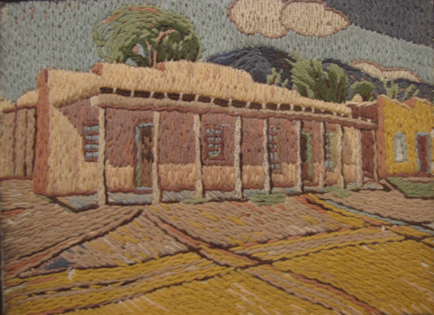
Kit Carson Home (colcha embroidery)

Adjunct to her painting, Edith pursued interests in doll making. By the 1940s she had abandoned painting and devoted space and energy to the "little doll factory" in her home. This served her well as she was able to support herself through doll-making in the years after her husband's death in 1946. 

Helen Campbell Martin


The artistic talent Helen Campbell (1888-1957) brought to Taos when she married Dr. T. P. "Doc" Martin  in 1917 centered on music. Doc, known as a 'horse and buggy doctor', had established his practice decades earlier and had hosted the formative meeting of the Taos Society of Artists in 1915. He was a civic-minded and well respected man in the community. Helen was already an accomplished violinist, but within months shifted her interest to the visual arts after exposure to other artists' work in the growing Taos colony. Her interest in fabric design blossomed after she learned the rudiments of the Oriental art of batik from Santa Fe artist Olive Rush. 

Untitled Batik wall hanging


Helen soon developed her own colors and treatment that she used in signature scarves, shawls, dresses and wall hangings. Women from high society in cities like New York, Paris and London clamored after Helen's dinner gowns, tea dresses and chiffon wraps. Her batik business flourished from 1920 until 1935 when her husband died. Helen inherited several buildings and called in outstanding debts (Doc seldom sent out bills) for labor to build up and open the Martin Hotel in 1936. From that time until her death in 1957, Helen put her energies into building what is now The Taos Inn, a landmark known as "the living room of Taos" that still extends the hospitality originally offered by Helen and Doc Martin.

Besides their photos, work, and stories, some of these women artists have left institutions as part of their legacy. They include the Blumenschein Home and Museum, the Harwood Museum of Art, the Eanger Irving Couse Home and Joseph Henry Sharp Studio, and the Taos Inn.
 
I hope you enjoyed meeting these early women artists AND if you're in town, please check out this exhibition. It's a MUST SEE, up until May 15th. If you don't make it, click on the Blumenschein Home and Museum link above, and you can take a brief virtual tour of "Out of the Background."


This begins to address "Who are the remarkable women of Taos?" Next I'll be in the kitchen with Mabel and the Remarkable Women Chefs of Taos, with Part Two of "Out of the Background" to follow after that.

Adios for now,
Liz

Thank you to Anita McDaniel, curator, Taos Historic Museums for photo and text assistance (and an insightful, interesting exhibition of the early women artists of Taos), and to Nancy Delpero, marketing and public relations at the Taos Historic Museums for the virtual video tour of the  "Out of the Background" exhibition. Photos and images presented here are part of the exhibition.


Saturday, April 7, 2012

2012 Remarkable Women of Taos year-long celebration launch -- Mabel Dodge Luhan makes the news

In mid-March the banners went up, announcing this year's  2012 Remarkable Women of Taos year-long celebration.

Taos Mountain sets off the new banners

And the news hit the press on a national scale.On March 14th Associated Press newswoman Susan Montoya Bryan's article, "Taos Embarks on Yearlong Celebration," appeared in the New York Times.Mabel loomed large in Susan's piece. Not only was Mabel credited with helping create a community where artists could thrive, by bringing writers Willa Cather and D.H. Lawrence, artists Georgia O'Keeffe and John Marin, and photographer Ansel Adams (among others) to Taos, she created an intellectual component. Speaking to this, Jina Brenneman, curator at the Harwood Museum of Art, said "We're seeing residuals of that today."

I've since discovered the range of newspapers that carried the article From the more local Santa Fe's New Mexican, the story spread to California's Bay Area News Group. In Texas it ran in Fort Worth's Star-Telegram and in the Houston Chronicle, and in Connecticut's Stamford Advocate, where you can see a variety of Taos photos including one of Millicent Rogers that provides a peek at one of the displays now on view at the Millicent Rogers Museum. Over the past weeks other gallery and museum exhibitions have opened that showcase women artists of Taos, both past and present. In future postings I will be sending you snapshots of these shows.

For now, however, I'd like to introduce the Remarkable Women of Taos special section published by The Taos News on March 22nd (now available on-line for your reading pleasure). In his introduction, Special Sections editor Andy Jones muses on such questions as "What is it about Taos that has allowed women to thrive for so long?" He speculates that it might have something to do with the area's relative isolation. In my own description of the Remarkable Women of Taos project, I state that women have long formed the backbone of this community. It interested me that Andy Jones' thoughts echoed my own: "If women weren't allowed to be creative and productive members of society, the fabric of the community would collapse."

John Dunn Shopkeepers: 28 women and 4 exceptional men. Photo: Gail Russell, © 2012


Business is one of the categories on the Town of Taos' remarkable women website. And since I wrote a profile on enterpreneur Polly Raye, I remembered her saying there was a high percentage of women-owned businesses in Taos. I phoned Polly earlier this week to garner her thoughts on this. Since she owns the John Dunn shops near Taos Plaza, I asked her how many of the 20 businesses were women-run. Polly replied that 16 were run by women and 4 by men. That sampling yields the equation of women owning and running of 4 in 5 or 80% of Taos businesses. That matches Andy Jones' statement about the long history of the Taos community's strong and inspiring business women: "In modern-day Taos the business world is nearly dominated by women."

As in so many other aspects, there's a thread that returns to Mabel, a woman who inspired Georgia O'Keeffe to create a full-blown life of her own. I find this fascinating.

Just recently I revisited an email from Canadian poet Kate Braid who responded to an e-blast I sent out in August 2010. In the e-blast I announced the intention of creating "The Year of Remarkable Women" and, with the help of many talented women and men, this has become a reality. After the successful March 22nd official media launch, I look at my own contributions to this year-long celebration.

As your blog host, I agreed to provide context and substance to the year's marketing campaign by helping generate exhibitions and events that currently run through December 8, 2012. Additionally, I researched and wrote nearly 40 profiles on remarkable historic and contemporary women (see above -- Town of Taos' remarkable women website and Taos News special sections links), and solicited nearly the same amount from our talented pool of  local writers. The long hours reduced the frequency of postings on this blog. However, I'm back and over the next weeks, you, dear readers, will reap the benefits of this work. And to think it all started with Mabel and this blog.

Adios for now,
Liz


P.S. Kate Braid and Lois Rudnick, Mabel's biographer, are headlining the Mabel Dodge Luhan House's workshop "Meetings with Remarkable Women" scheduled for June 1-3, 2012. There is still some room in this workshop. Go to the link for details.

*Photo courtesy of Polly Raye. Photo by Gail Russell, ©  2012.

Wednesday, March 7, 2012

Mabel Dodge Luhan and the Inaugural Remarkable Women of Taos Immersion weekend

In the synchronistic way of Taos, Remarkable Women events conjoined to create the inaugural immersion weekend showcase on the weekend of February 24th and 25th. For me, this weekend came as the culmination of months of long hours researching, writing and soliciting profiles of some of Taos's remarkable women and helping assemble a roster of Remarkable Women of Taos events (currently running through December 8, 2012).


One event grew out of a historic woman profile I was commissioned to write. If you've been following this blog, a historic scenic marker paying tribute to Mabel, Frieda Lawrence and Dorothy Brett provided the context for my first posting. The search for this marker led me to another one that featured Taos Pueblo potter Virginia T. Romero. To find out more about her life, this past winter I met with her children and their families to interview them. As none of these women's scenic markers had ever been dedicated (there is a 3rd one in Taos), we decided to bring them to public attention with a roadside dedication.

From attending the 2010 ribbon-cutting for the Peggy Pond Church/Marjorie Bell Chambers marker in Los Alamos, I learned about the New Mexico Women's Historic Marker Initiative and met some of its co-founders and members. Established in 2005 by members of the New Mexico Women's Forum, the initiative recognizes women's contributions to New Mexico on the state's Official Scenic Historic Markers. To date, the initiative (funded by the 2006 state legislature) has placed 64 historic markers throughout the state to ensure that "women's diverse histories will be remembered and told, and will inspire and provide a guide for future generations."

After settling on the date of February 25th with the Romero family, Mabel Dodge Luhan House staffer Karen Young and I helped with preparations for the roadside dedication of the Virginia T. Romero marker. As it turned out the date fell on the same day as the 90th anniversary celebration, "Who's Been Sleeping at Mabel's? Three Generations of Utopian Visions at the Mabel Dodge Luhan House." The timing coincided with exhibitions on women artists at three Taos museums that had opened weeks prior. And to top it off, on Friday, February 24th, to honor of the Remarkable Women of Taos and the 90th anniversary of the Mabel Dodge Luhan House, Las Taoseñas--"daughters, grandmothers, mothers and crones encompassing five decades of life"--hosted an evening of poetry and music that provided the entree into Saturday's full roster of events. We had the makings of the Inaugural Remarkable Women of Taos Immersion weekend, to officially launch the project--and it became the cover story in the Taos News' Tempo Magazine.


Virginia T. Romero    Photo © Stephen Trimble*

Here's what happened as writer Ariana Kramer told it:

     The remarkable women of Taos. Many have been noticed, but few have been noted down for posterity. That is about to change, and salon-hostess Mabel Dodge Luhan appears to be the responsible party.
      It all started when the women who currently run the Mabel Dodge Luhan House, now a retreat center, asked writer Elizabeth Cunningham to start a blog featuring Luhan and other "Remarkable Women of Taos."
    The project soon spiraled outward and the Town of Taos picked up the idea for its 2012 tourism theme. This weekend kicks off a year of activities celebrating the many women who have contributed to Taos' past and present. The effort aims to provide further insight into the contributions and qualities of those often remarked upon women like Luhan and her cohorts. It also hopes to share their limelight with the many influential Taoseñas who have pursued their passions unnoticed and unremarked upon.**

Adriana's story, "Unsung Heroines: Poetry, music, art and conversation celebrates the powerful women of Taos"  led with a quote from Virginia T. Romero: 

Nobody taught me how to make pottery. My mother made pots. I used to cook and do housework, but I saw her make them. I never thought I would touch the clay. Then one day my husband and my father went for clay. My father gave me a bag of clay and told me, “Daughter this will give you all you need—food, clothing and money.” And, you know, he was right. – Virginia T. Romero, 1989


And the Virginia T. Romero roadside marker dedication headlined the weekend events. At 11 a.m. on February 25th dignitaries from Taos Pueblo, the Town of Taos, the State of New Mexico and the family of Virginia T. Romero, visitors and the greater community turned out for the roadside dedication of the women's historic marker honoring Taos Pueblo potter Virginia T. Romero (1896-1998). The festivities, emceed by Virginia's great-grandson Clyde Romero Jr., opened with an song by the Taos Pueblo Drum group.

Taos Pueblo Drum Group    Photo © Rick Romancito ***

Among the speakers were Taos Pueblo Governor Laureano B. Romero (far left below) who expressed  pride on behalf of tribal members for the recognition this beloved grandmother received from the State of New Mexico.War Chief Ben Sandoval recalled that the multi-talented Virginia T. Romero made the traditional white wedding boots for his wife.

Robin Collier recording comments of Clyde Romero Sr.
 
The sons of Virginia T. Romero, Paul Romero and Clyde Romero Sr., told about their mother, a woman who was deeply connected and committed to the traditional lifeways of Taos Pueblo. A busy mother of 10 children, Virginia took time out from household chores and making pottery to bring lunch to the men who worked the fields of the corn, wheat and oats that helped sustain the family.


Examples of Virginia T. Romero's pottery

Family members recalled how Virginia's fame as a potter brought her worldwide recognition. Today her works are in the collections of the Los Angeles County Museum and the Southwest Museum of the American Indian (now part of the Autry National Center in Los Angeles), the School of American Research and the Museum of Indian Arts and Culture in Santa Fe, and the Millicent Rogers Museum in Taos.

New Mexico Cultural Affairs Secretary Veronica Gonzales addressed women's contribution to the state's history, part of "what makes us unique." Next Beverly Duran,  co-founder of the Women's Historic Marker Initiative, stated the importance of honoring the unsung women of New Mexico and how their stories might inspire young women to follow their example and a similar path.


The ceremony closed with an old beloved round dance song from the Taos Drum Group, one that Virginia T. Romero might have danced to. Afterwards Paul Romero invited Beverly Duran and six other representatives of the marker initiative to pose with him and some of Virginia's other children in front of the marker they had helped create.

Virginia T. Romero's children and members of the NM Women's Forum****

Then Virginia T. Romero's remaining children stepped up and took their places for a photograph. I quickly captured the moment because the Romeros had to leave within minutes. They and their relatives were hosting a traditional Taos Pueblo feast for all dignitaries and the community present at the honoring.

L-R: Celestino, Jimmy, Paul, Tony, Catherine and Clyde Sr.

Days later, Nancy Bartlitt (New Mexico Women's Forum member from Los Alamos) wrote me saying how honored she was to be invited to the dedication of the Historic Marker for Virginia T. Romero and how the event brought happiness to many lives. Nancy concluded her note: "It was fun to be in the open sky, huge mountains as the comforting backdrop, and see the faces of the family and Pueblo tribal members beaming with great pride."

I echo Nancy's sentiment. It gave me deep satisfaction to headline the weekend (and the year's events to follow) with the honoring of such a deserving remarkable woman from Taos Pueblo. I believe this would have pleased Mabel equally as much.

Stay tuned. I'll be introducing the remarkable women I've met and written about as well as keeping you posted on exhibitions and events (including our "Meetings with Remarkable Women" workshop) created around them.

Adios for now,
Liz

I would like to thank Rick Romancito, Ariana Kramer,The Taos News, Beverly Duran and Nancy Bartlitt for their contributions to this posting.

* Published in Talking with the Clay: The Art of Pueblo Pottery in the 21st Century  by Stephen Trimble, revised edition. Copyright 2007 by School for Advanced Research, Santa Fe, New Mexico.” Photo © 2012 Stephen Trimble / www.stephentrimble.net
 ** from "Unsung Heroines" by Ariana Kramer. Tempo Magazine/The Taos News, February 23-29, 2012:24-25.
*** Caption reads: "Little Kiana Bozzuto attends the roadside marker dedication honoring Taos Pueblo micaceous pottery-maker Virginia T. Romero, Saturday (Feb. 25) Photo courtesy of Rick Romancito, appeared in Tempo/The Taos News' March 1-7, 2012 edition: 38.
****Left to right:  Jimmy Romero, Paul Romero, Rhonda Faught, Barbara Beasley Murphy, Bev Duran, Paula Tackett, Catherine Romero, Nancy  Bartlit, Betty Downes. Present but not pictured New Mexico Women's Forum member Karen Durkovich.  

Saturday, January 14, 2012

News Flash: Launch of the 2012 Year of the Remarkable Women of Taos

It's official! The 2012 Town of Taos Remarkable Women of Taos media launch made a big splash in this week's Taos News. Covering up and overlapping the paper was a big cover page/fold out announcing this year's theme--tied to New Mexico's Centennial of Statehood.

So what does the Remarkable Woman of Taos encompass? Earlier, Cathy Ann Connelly,  Director of Public Affairs and Tourism for the Town of Taos, explained:

Each year, the Town puts together a traveler education media theme for Taos’ creative community to pinpoint the traveler who will appreciate what we offer, educate them about Taos, and attract them to visit the area that year. This year, in conjunction with the state’s centennial, we are celebrating our remarkable women and underscoring why they were drawn to Taos’ unique and wonderful attributes.

My part in this? I helped lay the groundwork by identifying, researching and writing  about remarkable women, helping conduct planning meetings, and creating or assisting with the creation of events. Mabel's biographer Lois Rudnick, Karen Young (my "guidian" angel at the Mabel Dodge Luhan House) and I have two Remarkable Women of Taos events already on the books: the 90th anniversary of the Mabel Dodge Luhan House (building completion in 1922) in February, and our workshop "Meetings with Remarkable Women" scheduled for June 1 through 3, 2012. (*See note below my signature.)


You may be interested to know that the Town of Taos hired me to write 30 profiles on historic and contemporary women. The photos above represent 4 of those women: at the top weaver and Weaving Southwest gallery owner Teresa Loveless (and her grandmother, the famous weaver Rachel Brown); top left Mabel pictured with her husband Tony; bottom left Adriana Blake third-generation family member and owner/operator of Taos Ski Valley; and on the right fashion designer Patricia Michaels from Taos Pueblo.

This wonderful work has occupied my thoughts and time (average 10 hours a day, 6 days a week) since last May. The effort took me away from this blog--but rest assured, I'm back with a Cecil B. DeMille cast of characters. You'll meet them on the blog. With so many women to tell you about, I'll be posting about 3 times a month. In the meantime, to read what I've written on historic and contemporary women, visit the new Town of Taos remarkable women website

Stay tuned!

Adios for now,


Liz


* Space is limited: workshop can accommodate 60; Mabel Dodge Luhan House has 19 rooms available for double or single occupancy.


Thursday, January 5, 2012

Mabel Dodge Luhan: Preview of the Year of the Remarkable Women of Taos

Happy New Year! This is the year of the Dragon, I’m told. It is also the year of the Remarkable Women of Taos, and it all started with this blog. But that’s another story…

On Friday at noon on January 6th the State of New Mexico’s inaugural event officially launches 100 years of statehood. I found this interesting because in Taos two events – one on the 5th, the other on the 7th – launch for me (in an unofficial way) the yearlong Centennial celebration of the Remarkable Women in Taos. As a preview to the women who will be featured and honored, I thought you might enjoy meeting the remarkable women featured in today’s and Saturday’s happenings.

Tonight SOMOS (the Society of the Muse of the Southwest) will host poetry readings Harwood Museum of Art  that enhance the exhibition “The Legacy of Black Mountain College.” Mabel would have loved this! Black Mountain College echoed her 1912-1915 salon through gathering movers and shakers in a forum for the exchange of innovative ideas. Like Mabel’s salon the experimental, interdisciplinary Black Mountain College served as an incubator for the American avant garde. The institution had quite an impact: as an important precursor, it provided a prototype for many alternative colleges that exist today. From 1933 to 1956 the college attracted faculty and lecturers like Buckminster Fuller, Merce Cunningham, John Cage, Josef Albers, Robert Creeley, Charles Olson, Willem and Elaine de Kooning, and Albert Einstein. Some of the students later became America’s leading designers, poets and artists, among them painters Robert Rauschenberg and Cy Twombly.

Photo by Kathleen Brennan, © 2012
 

Some Black Mountains students visited and/or settled in New Mexico. Of them two women who live in Taos will be honored tonight: Cynthia Homire and Barbara Harmon. Potter, poet and artist who attended Black Mountain College from 1950-54, Cynthia Homire’s most influential teachers were Charles Olson, Robert Creeley and Karen Karnes. She has lived and worked in Northern New Mexico since 1964, first as a potter in Santa Fe, then as a poet in Taos. What Cynthia had to say about her experience at the college gives a taste of what life was like there for her as a young woman:

Yes, I have rubbed shoulders with the pantheon, a few bellies, too.  Washed the floor Merce Cunningham danced on, then went leaping through his class. Jitterbugged with Rauschenberg, pointed out morels to John Cage, was instructed by Olson in long night classes to write from my roots, dirt and all, but take time out to dig up a few Mayans in Mexico.  Shared steak with William Carlos Williams (he said "I know you").  Cooked a Chinese meal for Eliot Porter and David Brower (before David took to chewing each bite thirty times before swallowing).  Breakfast with Brautigan.  All these things happen if you are there for them and maybe you make pots for 30 years and then maybe you write poetry.


Photo by Kathleen Brennan, © 2012


Barbara Sayre Harmon grew up in a sophisticated artist family – her father was the noted California landscape painter Fred Grayson Sayre. Barbara Sayre first came to Taos in 1946 to study with Emil Bisttram at the Bisttram School of Art. She arrived with her future husband, Cliff Harmon. The couple studied art three summers with Bisttram, and afterwards spent time at Black Mountain College (1949-1950). Barbara and Cliff worked in other places, then returned to Taos in the 1960s. Influenced by their experience at Black Mountain, as one of their projects the Harmons built the first solar home in Taos, anticipating the leadership others in Taos would take in solar resource development. By then both had developed new painting series. Previously Barbara did artistic bookbinding. Back in Taos she turned to painting still lifes and imaginative subjects drawn from fairy tales. At an early age Arthur Rackham’s watercolor illustrations in The Wind in the Willows inspired Barbara. She began to explore the art of classical fantasy English watercolor. Now, in her mystical, dreamlike images, she tries to bring about a sense of peace and contemplation in the viewer. Barbara also writes poems that are as whimsical as her paintings. 


Photo Los Alamos Historical Sciety, © 2012

On Saturday, January 7, Sharon Snyder will give a presentation for the Taos County historical Society based on her recently released biography on Peggy Pond Church titled At Home on the Slopes of Mountains. Peggy Pond Church, who lived in Taos from 1946 to 1956 (her brother Ashley Pond was Mabel Dodge Luhan’s doctor in Taos) has been called the First Lady of New Mexican Poetry, "a significant American voice." Sharon Snyder’s biography tells Peggy’s story, tracing her life through a great flood, through canyons and ruins, trails and tall pines on the Pajarito Plateau (the landscape surrounding present-day Los Alamos), and the loss of her home to the Manhattan Project of World War II. Born in 1903 on a ranch in the Territory of New Mexico, Peggy lived in Pajarito Canyon and at the Los Alamos Ranch School before being uprooted during the war to live the second half of her life in Taos, Berkeley, and Santa Fe. Although her poetry has many inspirations and sensitive observations of land and people, she once described it by saying, "It's the land that wants to be said." Church’s journey is revealed also in her books of poetry and prose. She wrote eight volumes of poetry during her life, and many poems are still being published in anthologies on women, nature, and the American West. Her memoir of Edith Warner, The House at Otowi Bridge has become a Southwest classic. In 1984 Peggy received the Governor's Award for Excellence and Achievement in the Arts and was also named a Living Treasure of Santa Fe. She died in 1986.

On January 13th the Town of Taos plans to launch its media campaign for The Remarkable Women of Taos. I will post an overview of the year around that time and relate my experiences as I interviewed contemporary women and researched their historic counterparts.

Stay tuned.

Adios for now,
Liz

P. S. As part of the year's Remarkable Women of Taos events, The Mabel Dodge Luhan House has planned a workshop, "Meetings with Remarkable Women."


Thank you to photographer and filmmaker Kathleen Brennan for providing photos of Cynthia Homire and Barbara Harmon. Kathleen interviewed them for and featured them in her new documentary film Vast Spaces, Unique Vistas: The Artists of Black Mountain College and the New Mexico Connection, which airs tonight as part of this evening's poetry reading at the Harwood.

Fellow writer and compadre Sharon Snyder provided the photo of Peggy Pond Church. Thanks, Sharon.

Appreciation to Jan Smith and Dori Vinella of SOMOS for providing informative material on Cynthia Homire and Barbara Harmon.